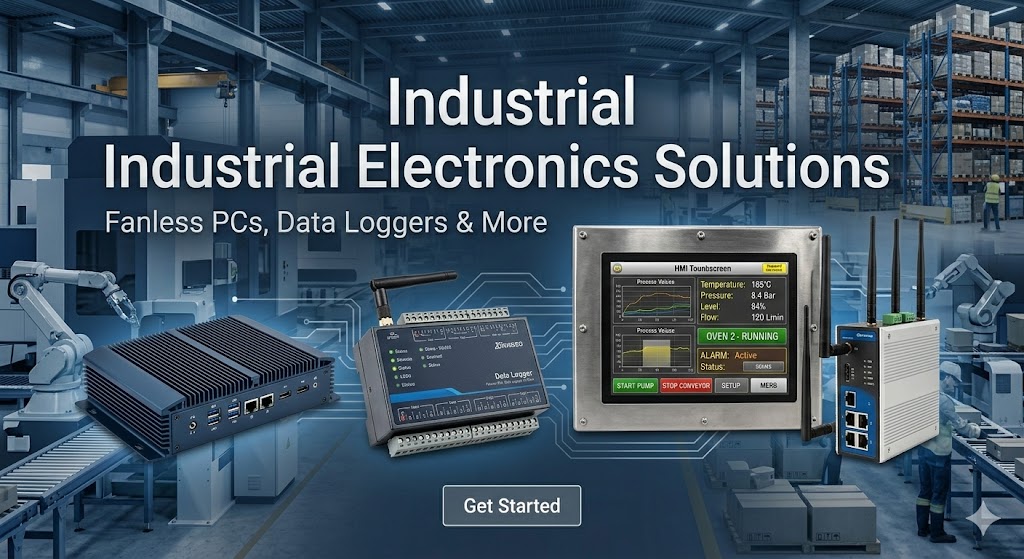
What Is a Fanless Industrial PC?
A fanless industrial PC is a computing system engineered to operate without the active cooling fans found in conventional computers, relying instead on passive thermal management — heat sinks, heat pipes, and thermally conductive chassis materials — to draw heat away from processors and other components and dissipate it safely through the outer casing. This fundamental design difference eliminates the ventilation openings that fans require, allowing the system to be completely sealed against the entry of dust, moisture, and airborne contaminants that would otherwise compromise electronic components over time.
Passive cooling works by creating a direct thermal pathway from heat-generating components to the outer chassis, which acts as a large-area heat sink in contact with the surrounding environment. The engineering required to achieve effective passive cooling across a wide range of operating conditions is sophisticated — involving careful component selection, precision thermal interface materials, and chassis geometries optimised for natural convection — and it is this engineering investment that distinguishes a genuine industrial fanless PC from a consumer mini PC that happens to lack a fan.
The absence of moving parts in a fanless industrial PC delivers consequences that extend well beyond dust exclusion. With no fan bearings to wear out and no fan motors to fail, the system eliminates two of the most statistically common causes of unplanned computer failure in industrial environments. This mechanical simplicity is a deliberate engineering choice that produces a system with fewer components that can degrade or fail, and therefore a system that is inherently more reliable over its operational life.
Reduced maintenance is one of the most tangible day-to-day benefits of the fanless design. Fan-cooled systems in industrial environments require regular filter cleaning, periodic fan replacement, and ongoing monitoring of cooling performance — tasks that accumulate into meaningful maintenance labour and parts costs over time. Fanless systems require no filter maintenance, no fan replacement, and no cooling system monitoring, reducing the maintenance burden to essentially zero for the cooling system itself.
The lifespan advantage of fanless industrial PCs relative to their fan-cooled counterparts is substantial and well-documented in industrial operations experience. While commercial PCs typically reach end-of-reliable-life within three to five years in industrial settings, properly specified fanless industrial systems regularly remain in dependable service for eight to fifteen years. This longevity is the direct result of removing mechanical components subject to wear, sealing the system against the contamination that degrades electronics over time, and specifying industrial-grade components rated for extended operational life.
Silent operation is a practical benefit in environments where acoustic noise has operational significance — quality control areas, laboratories, control rooms where concentration and communication matter, and public-facing industrial installations where noise standards apply. The distinction between an industrial fanless PC and a commercial or consumer computer goes far beyond the presence or absence of a fan — industrial systems are built with components specified for extended temperature ranges, higher vibration tolerances, and longer mean times between failure, supported by manufacturers with long-term product availability commitments measured in years rather than months.

Benefits of Fanless PCs for Harsh Environments
Dusty factory floors represent one of the most common and damaging environments for conventional computing hardware. Metal filings, wood dust, chemical particulates, carbon black, and general airborne debris are drawn directly into fan-cooled systems through their ventilation openings, accumulating on circuit boards, clogging heat sinks, and creating conductive bridges between components that cause short circuits and premature failures. A sealed fanless industrial PC provides complete protection against this contamination pathway, operating reliably in the same dusty conditions that routinely destroy standard hardware within months of deployment.
High-temperature operating environments — areas adjacent to furnaces, kilns, ovens, and heat-generating industrial equipment, as well as unshaded outdoor installations in NSW's hot summers — are well within the design envelope of a properly specified fanless industrial PC. With extended operating temperature ratings of up to +70°C or beyond available in commercial industrial platforms, fanless systems can be deployed in thermal environments that would cause standard PCs to throttle their performance, trigger thermal shutdowns, or suffer heat-related component degradation.
Shock and vibration resistance is a critical performance characteristic for fanless industrial PCs deployed near heavy machinery, in mobile and vehicle-mounted applications, and in mining environments where blast vibration and heavy equipment operation are everyday realities. Standard PCs are not designed to withstand continuous mechanical stress, and the consequences — failed solder joints, damaged connectors, crashed hard drives — are predictable and expensive. Industrial fanless PCs rated to relevant vibration and shock standards, and specified with solid-state storage, are engineered to absorb and tolerate these mechanical stresses without performance degradation.
Twenty-four-seven operation reliability is a non-negotiable requirement for many industrial computing applications — SCADA systems, continuous monitoring platforms, process control computers, and communication gateways that support operations running around the clock, every day of the year. Consumer and commercial hardware is not rated or designed for continuous operation at this intensity. Industrial fanless PCs are designed, tested, and specified for continuous operation, and their passive cooling systems perform consistently regardless of whether the system has been running for one hour or one year without interruption.
Reduced downtime is the operational benefit that most directly translates the technical characteristics of fanless industrial PCs into business value. Every hour of unplanned downtime in a production environment carries a cost — lost output, idle labour, emergency maintenance, and potential safety implications. The higher inherent reliability of fanless industrial hardware, combined with the elimination of the maintenance events that take fan-cooled systems offline, produces a measurable reduction in unplanned downtime that more than justifies the premium over commercial hardware in any application where continuous availability matters.
Industrial-grade components are the foundation upon which all other benefits of a fanless industrial PC rest. Capacitors rated for extended temperature ranges, connectors specified for thousands of mating cycles, PCBs with conformal coating for moisture resistance, and processors drawn from industrial rather than consumer supply chains — these are the component-level choices that determine whether a fanless system actually delivers on its promised reliability in service. Esis specifies and supplies only systems built to genuine industrial component standards, and we verify these specifications for every product we recommend to our NSW clients.
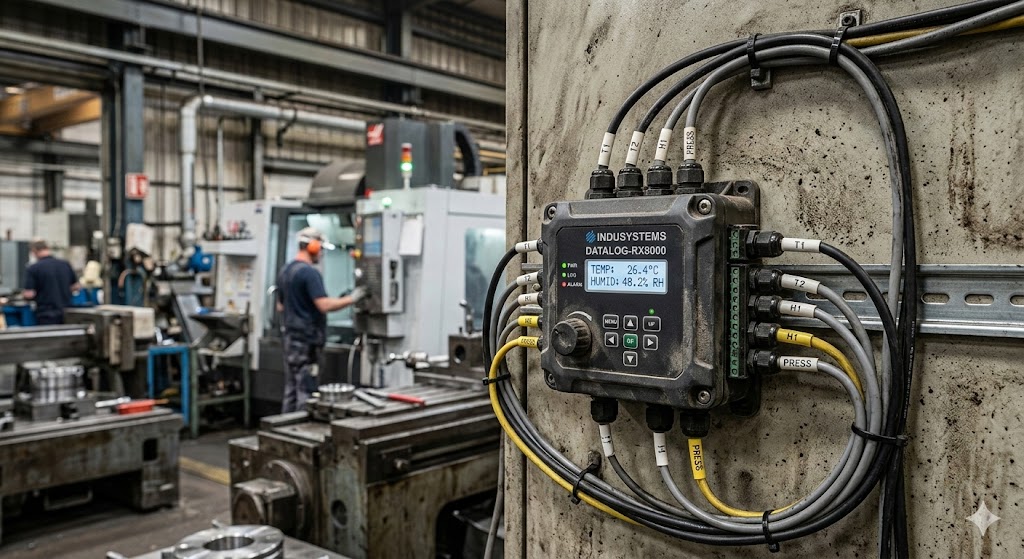
Processor, RAM & Storage Options
The processor at the heart of your fanless industrial PC determines the computational ceiling of your system — the maximum complexity of workload it can handle, the speed at which it processes data, and the headroom available for application growth over its operational life. Getting the processor specification right requires an honest assessment of both current and anticipated workload demands, because the incremental cost of specifying a more capable processor at the time of purchase is almost always lower than the disruption and expense of a field hardware upgrade driven by insufficient performance.
Entry-level processor configurations — typically Intel Celeron or Atom-based platforms — are well matched to applications with modest, well-defined computational demands: simple HMI terminals, basic data logging, barcode and RFID processing, and lightweight automation monitoring. These processors consume minimal power, generate little heat, and are straightforward to manage within a passive thermal envelope, making them ideal for applications where computational simplicity and low-power operation are priorities alongside rugged reliability.
Mid-range Intel Core i5 and i7 industrial processor platforms represent the sweet spot for the majority of demanding industrial applications — machine vision, multi-channel data acquisition, edge analytics, supervisory control, and complex protocol conversion. These processors deliver genuine multi-threaded performance capability within thermal envelopes that are well-managed by industrial passive cooling chassis, and they provide the computational headroom that most industrial applications require when their workloads grow over time. Esis recommends these platforms for the majority of NSW industrial computing projects.
RAM scalability is an important consideration for industrial PCs that will accumulate operational responsibilities over time. Applications that begin with modest memory requirements frequently grow — additional monitoring channels, more complex software, expanded data logging, and additional communication drivers all consume memory over the operational life of the system. Specifying RAM with headroom for this growth, or choosing a platform that supports future memory expansion, is consistently better decision-making than specifying exactly to current requirements and discovering the system is memory-constrained two years into its service life.
Solid-state storage is the only appropriate choice for fanless industrial PCs deployed in environments with vibration, temperature extremes, or continuous operation requirements. Mechanical hard disk drives are fundamentally incompatible with industrial conditions — their spinning platters and read/write heads are mechanical components subject to vibration-induced failure. Industrial-grade SSDs and eMMC storage deliver the reliability, temperature tolerance, and vibration resistance that industrial deployments demand, with write endurance and power-loss protection characteristics appropriate for continuous industrial operation.
RAID configurations — combining multiple storage devices in redundant arrays — are appropriate for applications where storage reliability and data integrity are mission-critical. RAID 1 mirroring provides automatic data redundancy across two drives, protecting against data loss from a single drive failure without operator intervention. Future-proofing your system through thoughtful initial specification is one of the most valuable things Esis engineers can help you accomplish — a system with expansion slots, processor headroom, RAM capacity above current needs, and storage architecture that supports growth will serve you far better over a decade of industrial service than a system specified exactly to today's requirements with no room to grow.
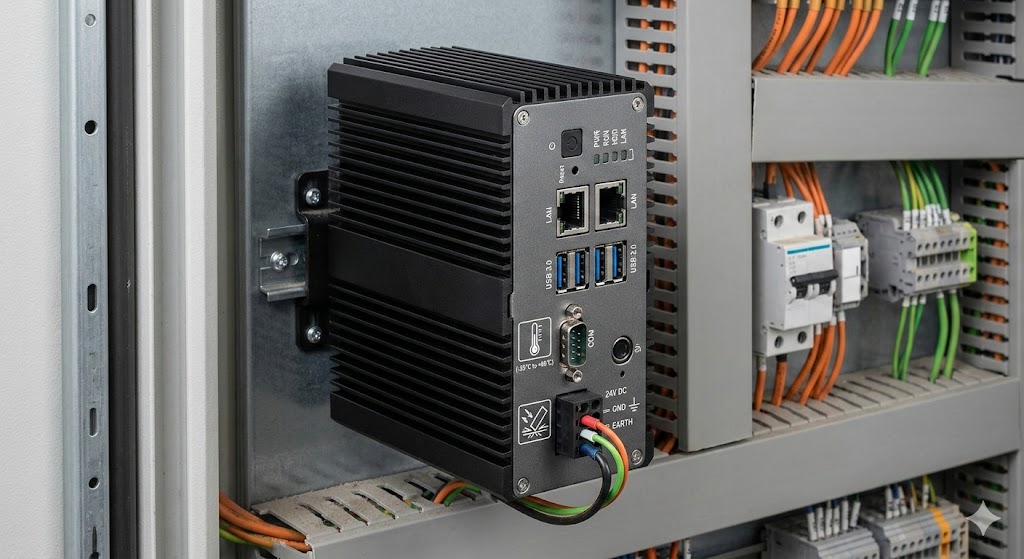
Connectivity & Expansion Capabilities
Serial communication ports — RS-232, RS-422, and RS-485 — remain the connectivity backbone of industrial automation environments, and their presence in adequate numbers on your fanless industrial PC is a non-negotiable requirement for most NSW industrial deployments. An enormous installed base of PLCs, sensors, instruments, scales, barcode readers, and legacy automation equipment communicates exclusively through serial protocols, and industrial fanless PCs from Esis are specified with multiple hardware serial ports — not software emulations — to ensure the reliable, low-latency serial communication that time-sensitive industrial applications require.
USB, Gigabit Ethernet, HDMI, and DisplayPort connectivity are standard features on industrial fanless platforms, but the industrial-grade implementation of these interfaces differs meaningfully from their consumer equivalents. Industrial USB ports incorporate retention mechanisms that prevent accidental disconnection in vibration-prone environments. Multiple Ethernet ports — typically dual GbE as a baseline — enable network segmentation between operational technology and IT networks, which is increasingly important for both cybersecurity and operational reliability in modern industrial installations.
PCIe expansion capability transforms a fanless industrial PC from a fixed-specification platform into a field-configurable system that can be adapted to changing application requirements without hardware replacement. Expansion slots allow the addition of additional serial port cards, wireless communication modules, frame grabbers, GPU accelerators, and specialised I/O hardware. When specifying expansion capability, verify both the number and physical format of expansion slots and the system's power budget for expansion cards, as passive thermal designs have defined thermal envelopes that limit total card power dissipation.
Wireless connectivity options — integrated Wi-Fi, Bluetooth, and 4G/5G cellular modules — are increasingly specified for industrial fanless PCs as edge computing, remote monitoring, and IoT integration requirements proliferate across NSW industrial sectors. Industrial-grade wireless implementations give careful attention to antenna design, with external antenna connectors allowing the use of remote antennas mounted outside metallic enclosures where internal antennas would be attenuated. For applications where wireless connectivity reliability is operationally critical, Esis engineers assess antenna placement and signal propagation as part of the system specification process.
IoT compatibility is a rapidly growing connectivity requirement for industrial fanless PCs deployed as edge nodes in industrial internet of things architectures. Modern industrial fanless platforms support the communication protocols, data serialisation formats, and security frameworks of industrial IoT — including MQTT, OPC-UA, Modbus TCP, and EtherNet/IP — either natively or through software stacks that run on standard industrial operating systems. Esis works with clients integrating fanless PCs into new or existing IoT architectures to ensure the selected platform supports the specific protocol stack and data pipeline their application requires.
PLC integration is a connectivity requirement that shapes both the communication hardware and the software environment of industrial fanless PCs deployed in automation and process control applications. Whether your PLCs communicate via traditional serial protocols, industrial Ethernet variants such as PROFINET, EtherNet/IP, or Modbus TCP, or more specialised fieldbus standards, Esis engineers verify that the fanless PC platform specified for your application supports the required communication interfaces and is compatible with the HMI, SCADA, or custom software managing your PLC network.
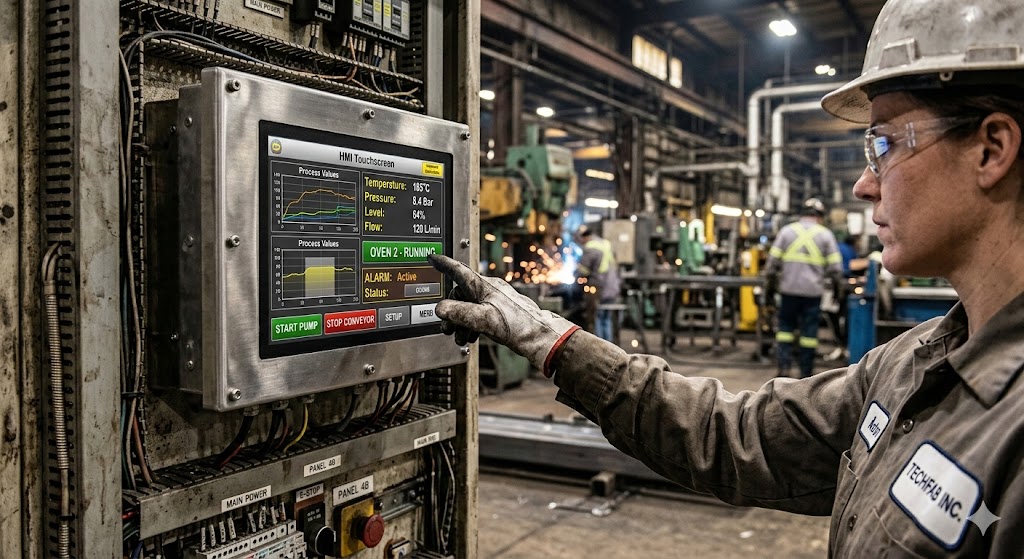
Mounting & Form Factors
DIN rail mounting is the most common installation configuration for fanless industrial PCs deployed within electrical cabinets, switchboards, and industrial control enclosures across NSW manufacturing, utilities, and process industries. DIN rail-compatible fanless systems clip securely onto standard 35mm DIN rail using integrated mounting hardware, positioning the computer alongside power supplies, relays, I/O modules, and other cabinet components in a space-efficient, organised arrangement. Esis stocks a comprehensive range of DIN rail-mountable fanless platforms suited to everything from lightweight HMI applications to demanding multi-protocol communication gateways.
Wall mounting provides a practical and space-efficient installation solution for applications where the fanless PC needs to be deployed in open or semi-open environments without a dedicated enclosure. Wall-mount bracket accessories allow direct attachment to machine bodies, structural walls, equipment frames, and mounting panels. This configuration is common in warehousing, logistics, light manufacturing, and utility monitoring applications where the computer needs to be accessible and visible without the complexity and cost of a full cabinet installation.
Rack mount systems in 1U or 2U 19-inch configurations are the appropriate form factor for server room installations, centralised control rooms, telecommunications cabinet deployments, and any environment where multiple industrial computing units need to be managed together in a structured, accessible arrangement. Rack-mount fanless industrial PCs combine the physical familiarity of IT infrastructure with the environmental toughness of industrial hardware, providing a natural integration point for mixed IT/OT environments.
Compact embedded units represent the smallest form factor category in the fanless industrial PC range and are designed for integration directly into machine enclosures, equipment cavities, and space-constrained installation environments where a separate computer housing is impractical or impossible. These ultra-compact systems — some measuring less than 150mm in any dimension — carry full industrial-grade connectivity and environmental protection in a footprint small enough to integrate into almost any equipment design, making them a popular choice for OEM machine builders and equipment integrators working with tight spatial constraints.
Outdoor enclosures for fanless industrial PCs provide the additional environmental protection required for deployments exposed to direct sunlight, precipitation, extreme temperature cycling, and airborne contaminants in uncontrolled outdoor environments. NEMA 4X or IP66-rated outdoor enclosures housing industrial fanless PCs are a standard solution for NSW outdoor industrial monitoring, infrastructure control, and remote automation applications. Esis can supply fanless PC systems pre-integrated into appropriate outdoor enclosures, fully tested and ready for field installation.
Custom enclosures are available for applications with unique physical, environmental, or aesthetic requirements that standard off-the-shelf enclosure products cannot accommodate. Working with specialist enclosure fabricators and our own engineering team, Esis designs and supplies custom fanless PC enclosure solutions for OEM equipment builders, specialised industrial applications, and deployments with non-standard mounting geometries, unusual environmental challenges, or specific regulatory requirements. Custom enclosure projects are managed with the same engineering rigour and attention to thermal performance that characterises all Esis fanless industrial PC solutions.
Custom Fanless PC Solutions
Tailored fanless industrial PC builds are at the core of what differentiates Esis from catalogue-based hardware distributors. Rather than presenting a fixed range of standard configurations and asking clients to select the closest available option, we begin every project with a thorough understanding of the specific application, environment, and operational requirements before making a single hardware recommendation. This application-first approach consistently produces better outcomes than specification-by-catalogue, because the hardware selected is genuinely matched to the work it needs to do.
Application-specific design encompasses every aspect of a fanless industrial PC build — from processor and memory selection through I/O configuration, storage architecture, operating system, and software pre-installation, to enclosure selection and integration testing. For projects with highly specific requirements — unusual I/O combinations, specialised communication protocols, extreme environmental conditions, or tight physical constraints — Esis engineers work through each design dimension systematically to arrive at a configuration that meets every requirement without unnecessary cost or complexity.
Industry compliance is a non-negotiable aspect of many NSW industrial computing deployments, and Esis has the knowledge and experience to specify systems that meet the relevant standards for your sector. Mining applications may require systems compliant with relevant AS/NZS standards for electrical equipment in hazardous areas. Food and pharmaceutical processing environments have hygiene and cleanability requirements that influence enclosure selection. Transport and defence applications carry their own regulatory and environmental compliance requirements. Whatever your compliance framework, our engineers ensure the systems we supply meet it.
Testing and validation before deployment is a standard part of the Esis custom solution process, not an optional premium service. Systems are bench-tested against the application software, communication interfaces, and operational parameters of the target deployment before leaving our facility, identifying and resolving compatibility or performance issues in a controlled environment rather than during a live commissioning event on a customer site. This pre-deployment testing investment consistently reduces commissioning time and gives clients the confidence of knowing their hardware has been validated before installation.
Pre-installed software is a service that eliminates a significant source of commissioning complexity and risk for many industrial computing projects. Esis can supply fanless industrial PCs with your required operating system, industrial software suite, communication drivers, and application software pre-installed, configured, and tested before delivery. Receiving a system that is ready to connect and run rather than requiring hours or days of software configuration and troubleshooting on-site is a meaningful productivity advantage that our clients consistently value.
Long-term support commitments are a fundamental part of the Esis value proposition for industrial computing clients. We maintain relationships with our industrial platform suppliers to ensure long-term product availability for spares and replacements, we stock critical spare components for the systems we supply, and we provide ongoing technical support for the hardware and software environments of the systems we have delivered. When your production environment depends on a computing system we specified and supplied, our commitment to supporting that system does not end at the point of delivery.
Why Choose Esis in NSW?
Decades of experience in industrial computing and automation technology give Esis a depth of practical knowledge about what works in real NSW industrial environments that no amount of product data sheet reading can replicate. We have seen the ways that inadequate hardware specification leads to premature failures in the field, the connectivity gaps that emerge when application requirements are not fully understood before purchase, and the operational consequences of deploying systems that are not genuinely suited to their environment. This experience informs every recommendation we make and every configuration we specify.
Qualified engineers with hands-on experience in industrial computing, automation, and control systems are the foundation of Esis's technical capability. Our team understands industrial communication protocols, PLC integration, SCADA architecture, and the electrical and environmental characteristics of NSW industrial deployments at a level that allows us to engage meaningfully with the technical complexity of our clients' applications. When you bring a challenging application to Esis, you are working with engineers who have genuinely encountered and solved similar challenges before.
Local support from a NSW-based team means that when you need technical assistance, you are not waiting for a response from an interstate call centre or an offshore support desk. Esis engineers are available for face-to-face consultation, on-site visits, and same-business-day phone and email support for clients across NSW. In industrial computing, where system failures have immediate operational consequences, the difference between local support and remote support is measured in hours of downtime — and those hours carry real costs.
Trusted by major NSW organisations across mining, manufacturing, utilities, transport, and government infrastructure, Esis has built its reputation through a consistent record of delivering industrial computing solutions that perform as specified in the environments they were designed for. Our reference list includes some of the largest and most demanding industrial operations in New South Wales, and the longevity of our client relationships — many of which span a decade or more — reflects the confidence these organisations place in our technical competence.
Eliminating purchasing risk is a conscious design goal of the Esis engagement model. Industrial technology procurement carries inherent risk — the risk of specifying hardware that is inadequate for the application, the risk of purchasing equipment that does not integrate with existing systems, and the risk of making a significant capital investment in technology that fails prematurely in service. Esis reduces these risks through rigorous application assessment, thorough specification, pre-delivery testing, and the kind of engineering accountability that comes from a supplier who stands behind what they recommend and remains available to support it after delivery.
Ongoing service support means that the Esis relationship with your organisation does not conclude when your system is commissioned and running. We provide proactive system health reviews, software update guidance, spare parts supply, and responsive technical support throughout the operational life of every system we deliver. As your applications evolve and your operational requirements change, Esis engineers are available to assess whether your existing systems need modification or augmentation, and to help you plan technology refresh cycles that minimise disruption to your operations. With Esis, you are investing in a long-term technical partnership, not a one-time hardware transaction.