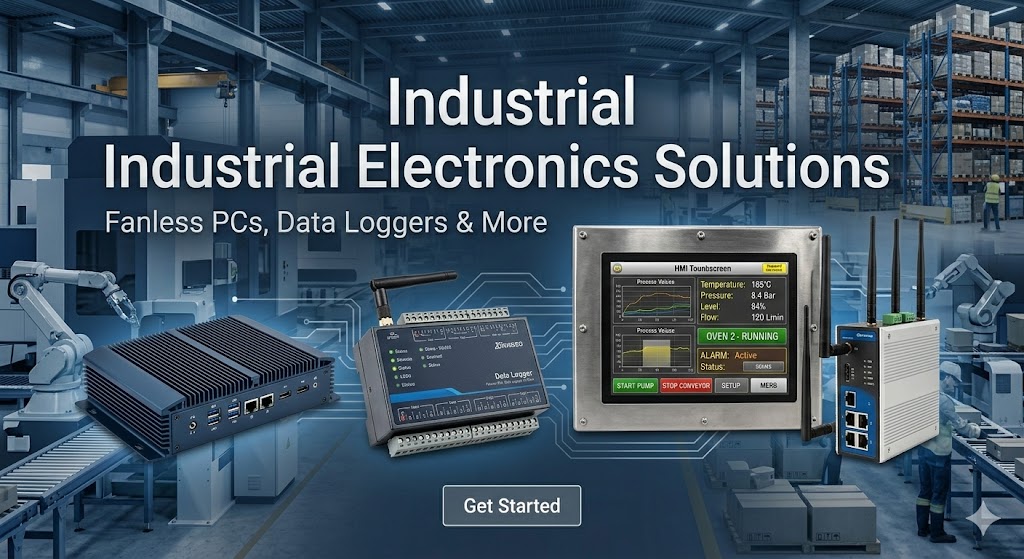
1. What Is an Industrial Panel PC?
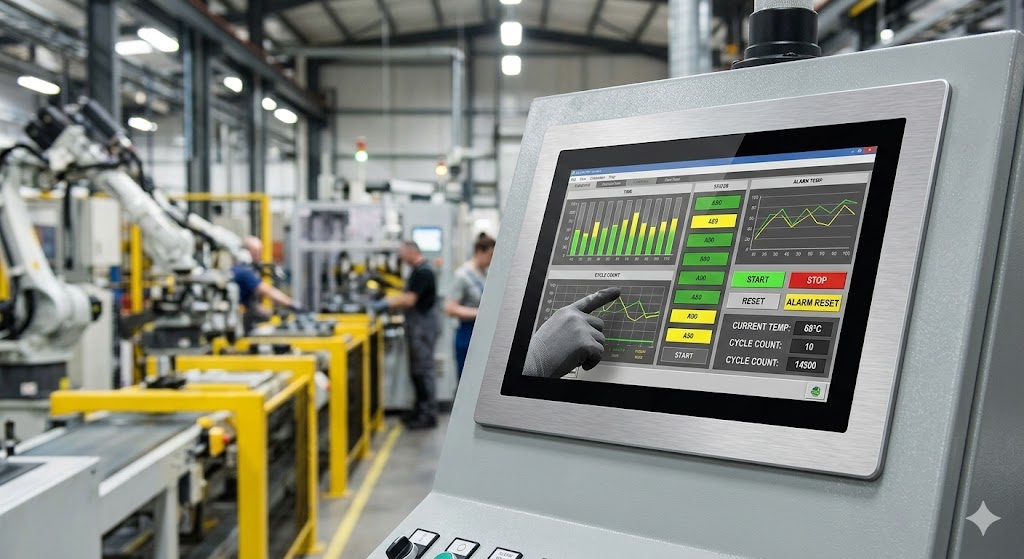
An industrial panel PC is an all-in-one computing system that integrates a display screen, central processing unit, memory, storage, and input interfaces into a single self-contained unit engineered specifically for industrial deployment. Unlike conventional computing setups that require separate monitors, computer towers, keyboards, and the cabling to connect them, a panel PC consolidates everything into one flat-panel enclosure that mounts directly onto machinery, control panels, walls, or industrial equipment without the physical complexity and failure risk of a multi-component arrangement.
The integrated display and CPU configuration is what gives industrial panel PCs their defining practical advantage in industrial settings. With all computing hardware housed behind the display in a single sealed enclosure, there are no external cables connecting separate components, no exposed connectors vulnerable to contamination or mechanical stress, and no complex wiring arrangements to maintain or troubleshoot. The entire computing and interface capability of the system is contained within one unit that presents a clean, flat front surface to the operator and an engineering-optimised rear to the installation environment.
Industrial panel PCs are built specifically for automation and process control applications — the environments where computing reliability is most critical and environmental conditions are most demanding. The hardware selection, thermal management design, power supply specification, and enclosure construction of an industrial panel PC all reflect the requirements of continuous operation in industrial settings rather than the intermittent use patterns and controlled environments of commercial computing.
The harsh setting capability of industrial panel PCs extends across a comprehensive range of environmental challenges. Dust ingress, moisture exposure, chemical contact, temperature extremes, vibration, mechanical shock, and electromagnetic interference are all conditions that industrial panel PCs are designed and certified to withstand. This environmental resilience is validated through internationally recognised testing and certification standards — IP ratings, IEC standards, MIL-SPEC shock and vibration testing — that provide objective evidence of a system's capability to perform in the conditions where it will be deployed.
The compact footprint of an industrial panel PC makes it deployable in installation locations where conventional computing hardware simply cannot fit. Control panel cutout mounting, swing-arm mounting, VESA mounting, and machine-surface mounting configurations all allow industrial panel PCs to be positioned precisely where operator access is needed — at the machine, at the control station, at the process point — without requiring a separate equipment cabinet or workstation area to house computing hardware.
Touchscreen functionality in industrial panel PCs goes well beyond the basic touch capability of consumer devices. Industrial touchscreens are engineered for operation with gloved hands, stylus input, and repeated daily contact over years of continuous operation. They're sealed against contamination, constructed from hardened materials that resist scratching and impact, and available in touch technologies matched to the specific requirements of each deployment environment.
Industrial durability is the thread that runs through every aspect of an industrial panel PC's design, from the choice of enclosure materials to the selection of internal components. Stainless steel and heavy-duty aluminium enclosures, solid-state storage with no moving parts, fanless cooling architectures that eliminate mechanical wear, industrial-rated power supplies with wide input voltage ranges, and conformal-coated circuit boards that resist moisture and contamination — these are the design choices that separate a genuinely industrial product from a commercial device that has merely been given a rugged-looking case.

2. Key Benefits of Panel PCs
Space Saving & Easy Installation
The space-saving advantage of industrial panel PCs is immediately apparent in any control panel or machinery installation. By consolidating display, computer, and input interface into a single flat-panel unit, they reduce the physical footprint of the computing installation to a fraction of what a conventional multi-component setup would require. This spatial efficiency is particularly valuable in environments where panel space is limited, where installation locations are constrained by machinery geometry, or where the overall compactness of a control system is a design priority.
Easy installation is a practical benefit that translates directly into reduced deployment cost and faster commissioning timelines. Industrial panel PCs are designed with standard mounting configurations — panel cutout, VESA, swing-arm, and rack mounting — that allow a single engineer to install and commission a unit efficiently without specialist tooling or complex assembly procedures. The elimination of separate component mounting, cable routing, and connection work means that installation time is measured in hours rather than days.
IP-Rated Protection & PLC Integration
IP-rated protection is the specification that makes an industrial panel PC deployable in environments that would quickly destroy conventional hardware. International Protection ratings — most commonly IP65 and IP66 for industrial panel PC front panels — certify the level of resistance to solid particle and liquid ingress that a unit provides. For NSW businesses operating in food processing, outdoor infrastructure, washdown environments, or dusty industrial settings, IP-rated protection is not a feature — it's the baseline requirement for any computing hardware that will be expected to perform reliably in service.
Seamless PLC integration makes industrial panel PCs the natural choice for operator interface and control visualisation in automation environments where PLCs manage process logic and field devices. Most industrial panel PCs support the full range of industrial communication protocols — Modbus, PROFIBUS, EtherNet/IP, PROFINET, and others — that enable direct, reliable communication with the major PLC platforms deployed across NSW industrial operations.
Energy Efficiency & Long Lifecycle Support
Energy efficiency is an increasingly important specification consideration for NSW businesses managing operational costs and sustainability commitments. Industrial panel PCs, particularly fanless models with low-power processors, consume significantly less electricity than conventional computing setups running equivalent software, and their efficient thermal management eliminates the energy cost of active cooling in many deployment configurations.
Long lifecycle support is a specification dimension that distinguishes industrial panel PCs from commercial computing hardware in ways that matter enormously to industrial operators. Industrial-grade products are specified and manufactured for operational service lives of five to ten years or more, with long-term component and product availability commitments from manufacturers that allow operators to maintain consistent hardware across a fleet of installations or source exact replacement units when needed.
Reliable performance under continuous operation is the fundamental promise of an industrial panel PC. Industrial panel PCs are tested and rated for 24/7 continuous operation across their full specified operating temperature range — a requirement that filters out components, thermal management designs, and power supply specifications that perform adequately in intermittent use but degrade or fail under the sustained stress of industrial deployment.
3. Touchscreen & Display Options
Resistive vs Projected Capacitive Touch
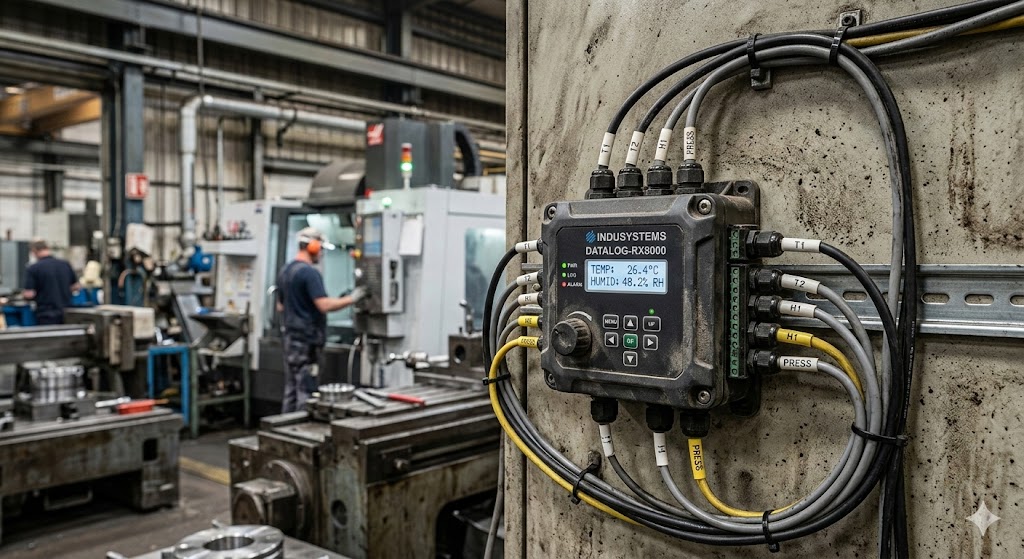
The choice between resistive and projected capacitive touch technologies is the most fundamental display specification decision for an industrial panel PC. Resistive touch technology responds to physical pressure from any object — a gloved finger, a stylus, even a pen cap — making it the preferred choice for environments where operators routinely wear heavy gloves or where precise stylus input is required. Projected capacitive touch offers superior touch sensitivity, multi-touch support, and a more responsive feel, making it the preferred choice for environments where bare-hand or light-glove operation is standard.
Screen Sizes & High Brightness Displays
Screen sizes for industrial panel PCs span a wide range to accommodate different installation locations, operator interface requirements, and application software display needs. Compact units from seven to ten inches are suited to tight mounting locations on machinery and small control panels. Mid-range displays from twelve to seventeen inches cover the majority of industrial HMI and SCADA interface applications. Large-format displays from nineteen inches and above serve central control room installations and multi-process monitoring applications.
High brightness displays are essential for industrial panel PCs deployed in environments where ambient light levels are high enough to wash out standard display panels. Industrial-grade high brightness displays — typically rated at 800 to 1500 nits or more compared to the 250 to 300 nits of standard commercial displays — maintain legibility in brightly lit factory environments, near windows, under industrial lighting, and in outdoor or semi-outdoor installations where sunlight exposure would render a standard display completely unreadable.
Outdoor Readable, Anti-Glare & Glove-Compatible Screens
Outdoor readable displays represent the highest performance tier of industrial display specification, combining high brightness panels with anti-reflective optical treatments and thermal management designed for exposure to direct sunlight and the full range of outdoor temperature conditions encountered in NSW. For panel PCs deployed on outdoor infrastructure, mining equipment, construction sites, and agricultural facilities, outdoor readable specification is the minimum viable standard for reliable operator visibility.
Anti-glare coatings address the reflection and contrast challenges that arise in industrial environments with strong directional lighting, reflective surfaces, or windows that create glare on display panels. Multi-touch capability enables gesture-based interaction — pinch to zoom, swipe, rotate — that can significantly improve operator efficiency when working with complex process visualisations or data displays that benefit from intuitive spatial manipulation.
Glove-compatible screens are a practical necessity in any industrial environment where personal protective equipment requirements mandate gloved hand operation. Industrial panel PCs with glove-compatible PCAP touch technology are calibrated to detect the attenuated electrical signal produced by a gloved finger, enabling reliable touch interaction without compromising the hand protection that industrial safety requirements demand.
4. Environmental Protection & IP Ratings
IP65, IP66 & IP67 Protection
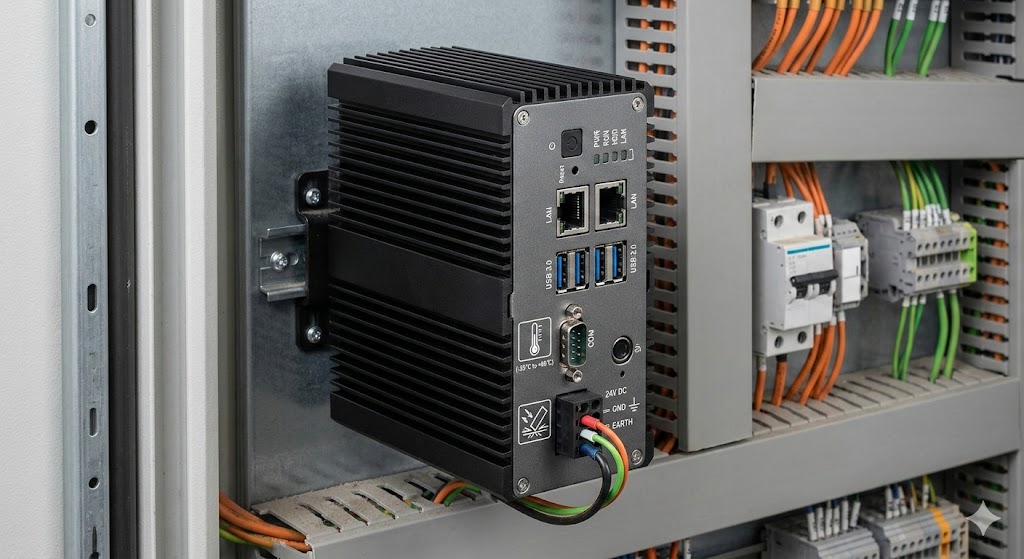
IP65 front panel protection is the baseline specification for industrial panel PCs deployed in any environment where dust or liquid exposure is a possibility, covering the overwhelming majority of NSW industrial installation contexts. An IP65 rating certifies that the front panel of the unit is completely dust-tight and resistant to water jets projected from any direction at standard pressure, making it deployable in general manufacturing, light wash-down environments, and dusty processing facilities.
Waterproof protection beyond IP65 — specifically IP66 and IP67 ratings — is required for industrial panel PCs deployed in environments where more aggressive liquid exposure is expected. IP66 certification adds resistance to powerful water jets, making it appropriate for food processing facilities, beverage production plants, and pharmaceutical manufacturing environments where regular high-pressure wash-down cleaning is part of the sanitation protocol. IP67 adds protection against temporary immersion in water to a defined depth and duration.
Dustproof Enclosures & Vibration Resistance
Dustproof enclosures are critical in mining, quarrying, cement production, grain handling, and any other industrial environment where fine particle contamination is a pervasive and continuous challenge. Dust ingress into computing hardware causes overheating by insulating heat-generating components, creates electrical short circuits, damages moving parts, and progressively degrades performance until failure occurs. Industrial panel PCs with fully dust-tight enclosure ratings eliminate this failure mode entirely.
Vibration resistance is engineered into industrial panel PCs at the component level, the assembly level, and the mounting level to ensure reliable operation in environments where mechanical vibration from operating machinery is a constant background condition. Solid-state storage eliminates the vibration sensitivity of conventional mechanical hard drives, conformal coating protects circuit boards from vibration-induced solder joint fatigue, and vibration-dampened mounting systems absorb energy from the installation surface before it reaches sensitive internal components.
Temperature Tolerance, Shock Resistance & Industrial Compliance
Temperature tolerance across an extended operating range is what allows industrial panel PCs to be deployed in environments that are simply inaccessible to commercial computing hardware. Fanless thermal designs using aluminium heat-sink enclosures that conduct heat away from processing components without moving parts enable reliable operation at ambient temperatures from below freezing to well above the limits of commercial hardware — essential for NSW businesses operating cold storage facilities or outdoor infrastructure in the summer heat of western NSW.
Shock resistance in industrial panel PCs addresses the impact events that occur in operating environments where heavy equipment is handled and materials are transported. Military standard shock testing — MIL-STD-810 — defines the shock profiles that ruggedised industrial electronics must survive without damage or performance degradation.
Industrial compliance across relevant standards and certifications is the objective framework that validates the environmental protection capabilities of industrial panel PCs. CE marking, UL certification, ATEX certification for deployment in explosive atmospheres, and IP rating standards all contribute to a compliance profile that gives NSW businesses documented, independently validated assurance that the hardware they're deploying meets the requirements of their specific industrial environment and any applicable regulatory framework.
5. Integration with PLC & Automation Systems
PLC Compatibility & SCADA Integration
Compatibility with major PLC brands is a non-negotiable requirement for industrial panel PCs deployed as operator interface and control visualisation hardware in NSW automation environments. The major PLC platforms represented across NSW industry — Siemens SIMATIC, Allen-Bradley, Schneider Electric Modicon, Mitsubishi MELSEC, Omron, and Beckhoff among others — each use specific communication protocols and software interfaces. Esis specifies industrial panel PCs with the connectivity and software compatibility required for reliable integration with each customer's specific PLC environment.
SCADA integration is the software layer through which industrial panel PCs deliver process visibility and operator control capability across complex industrial operations. SCADA platforms — Wonderware System Platform, Inductive Automation Ignition, Rockwell FactoryTalk View, Schneider Electric EcoStruxure, and Citect among many others — run on the Windows operating environments of industrial panel PCs and communicate with field devices, PLCs, and historian databases through the connectivity infrastructure of the panel PC platform.
HMI Solutions & Network Connectivity
Factory automation systems integration encompasses the full range of automation hardware and software components that industrial panel PCs need to communicate with in modern manufacturing environments — robotic systems, conveyor control, vision systems, barcode and RFID readers, weighing systems, and quality inspection hardware. The broad connectivity options available on industrial panel PCs — serial, Ethernet, USB, digital I/O — combined with the flexibility of their Windows or Linux operating environments make them capable of serving as central integration points in complex automation architectures.
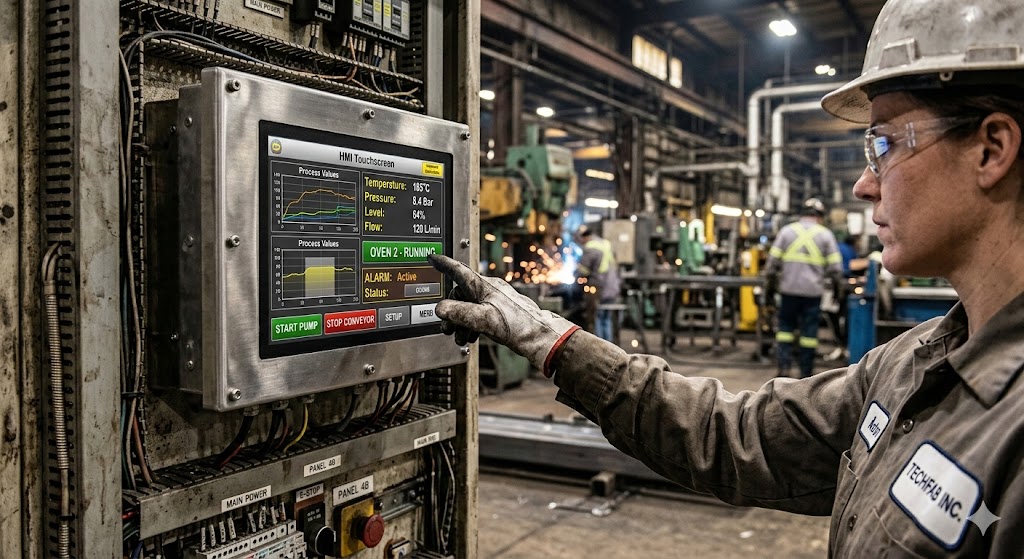
HMI solutions built on industrial panel PC platforms give operators direct, intuitive access to the process information and control functions they need to manage industrial operations effectively. The combination of a responsive industrial touchscreen interface with purpose-designed HMI software creates an operator experience that is both more usable and more reliable than earlier generations of dedicated HMI terminals.
Network connectivity for industrial panel PCs in NSW industrial environments spans both operational technology networks and corporate IT networks that provide connectivity to ERP systems, cloud platforms, and enterprise data infrastructure. Industrial panel PCs with multiple Ethernet ports support simultaneous connection to both network layers with appropriate segmentation, maintaining the security separation that good operational technology practice requires while enabling the data flows between operational and business systems that digital transformation initiatives depend on.
Real-Time Monitoring & Data Logging
Real-time monitoring capability delivered through industrial panel PCs transforms raw process data into actionable operational intelligence that operators can act on immediately. Modern HMI and SCADA software running on industrial panel PC hardware provides live process visualisation, alarm management, trend displays, and key performance indicator dashboards that give operators the visibility they need to manage processes proactively and identify developing problems before they become failures.
Data logging compatibility enables industrial panel PCs to serve as local data collection and archiving nodes in operational technology environments where process history needs to be maintained for quality management, regulatory compliance, performance analysis, or predictive maintenance programs. Standard database connectivity, historian client software, and file-based logging capabilities allow industrial panel PCs to record process data in formats compatible with the data management platforms used across NSW industrial organisations.
6. Customisation Options
Custom Screen Sizes & Branded Enclosures
Custom screen sizes beyond the standard catalogue options available from industrial panel PC manufacturers are accessible through Esis for NSW customers with installation geometries, operator interface requirements, or aesthetic specifications that standard products don't address. Whether the requirement is for an unusually compact display to fit a constrained mounting location, a non-standard aspect ratio, or an oversized format for a central control room display application, our supplier relationships and engineering expertise allow us to source or specify display configurations that meet the precise requirements of each application.
Branded enclosures give NSW businesses the option to present industrial panel PC hardware with their own corporate identity rather than a generic manufacturer's finish — an option that is particularly relevant for OEM equipment builders, systems integrators, and organisations where visual brand consistency across their operational infrastructure is a commercial or corporate requirement. Custom colour finishes, logo application, and bespoke enclosure panel design are all achievable within the structural and environmental protection requirements of the industrial enclosure specification.
Special Mounting Configurations & Software Integration
Special mounting configurations address the enormous variety of physical installation situations found across NSW industrial environments. Flush panel mounting, surface mounting, swing-arm mounting, overhead mounting, vehicle console mounting, and rack mounting are all standard configurations that industrial panel PCs are engineered to support. For unusual installation geometries — angled panel faces, curved surfaces, non-standard cutout positions — our engineering team can work through the specific mounting requirements and identify or develop the hardware solution needed.
Software integration services from Esis extend the value of industrial panel PC hardware by ensuring that the software layer running on the hardware is configured, tested, and validated before the system reaches the customer's facility. Pre-loading of operating systems, HMI software, SCADA clients, and custom application software, along with configuration of network settings, security policies, and communication parameters, reduces the commissioning burden at the customer site and ensures that the system arrives ready for integration.
Pre-Configuration, Additional Ports & Industry-Specific Builds
Pre-configuration of industrial panel PCs to customer-specific hardware and software specifications is a service that Esis provides to reduce installation time, ensure consistency across multi-unit deployments, and minimise the technical burden on customers whose operational teams may not have deep industrial computing expertise. A pre-configured unit that arrives on site with all hardware options installed, all software loaded, and all communication parameters set to the customer's specifications can be installed, connected, and commissioned in a fraction of the time required for a base unit configured from scratch in the field.
Additional ports beyond the standard connectivity complement of a base industrial panel PC model are available through expansion options that Esis specifies and sources for customers with connectivity requirements beyond what standard products provide. Additional serial ports for legacy device communication, additional Ethernet ports for network segmentation, additional USB ports for peripheral connectivity, and specialised interfaces for specific industrial protocols are all achievable through internal expansion modules, external interface boxes, or custom-specification products.
Industry-specific builds represent the highest level of customisation available in the industrial panel PC category — complete system specifications developed for a particular industry application rather than a general-purpose industrial computing requirement. Esis has developed application knowledge across the major industrial sectors represented in NSW — food and beverage, mining, water utilities, manufacturing, energy, and logistics — and can draw on that knowledge to specify panel PC configurations that address the particular environmental, connectivity, software, and compliance requirements of each sector.
7. Why Esis Is Trusted Across NSW
Local engineering advice from a NSW-based team is one of the most practical distinctions between Esis and remote or online industrial computing suppliers. When you work with Esis, you're working with engineers who understand the specific industrial landscape of New South Wales — the sectors, the environments, the regulatory context, and the operational challenges that characterise industrial operations across the state. That local knowledge informs every recommendation we make, ensuring that the products we specify are genuinely appropriate for the environments they'll be deployed in.
Proven industrial experience across more than two decades of supplying and supporting industrial computing hardware in NSW gives Esis a depth of application knowledge that is simply not available from suppliers without that history. We've worked through the challenges that arise when industrial computing hardware meets real-world industrial environments, and that experience is embedded in how we approach every new customer requirement — anticipating integration challenges, identifying environmental risks, and recommending solutions that we know from direct experience will perform reliably.
A large and diverse client base across NSW industrial sectors means that Esis brings cross-industry insights to every customer engagement. Solutions that have worked well in food processing environments inform our recommendations for pharmaceutical applications. Experience in mining and resources deployments enriches our advice for heavy manufacturing customers. The breadth of our customer relationships across NSW industry creates a practical knowledge base that makes our advice genuinely more valuable than that of suppliers whose experience is narrower or more geographically dispersed.
Quick response to customer enquiries, technical support requests, and supply requirements is a service standard that Esis maintains as a fundamental commitment to our NSW customers. Industrial operations don't wait for slow procurement processes or delayed technical responses, and our customers need to know that when they contact Esis they'll receive a prompt, substantive, and practically useful response from someone with the knowledge to actually help.
Reliable supply of industrial panel PC products and accessories is maintained through our established relationships with leading industrial computing manufacturers and our active management of stock and supply chains to serve the needs of NSW industrial customers. We understand that hardware availability at the right time is as important as hardware quality, and we manage our supply relationships and inventory to minimise lead times and ensure that customers can proceed with their projects without being delayed by supply chain issues.
Technical consultation from Esis goes well beyond product selection support. Our team engages with customers at the system architecture level — helping to think through integration requirements, communication protocols, software platform compatibility, environmental specifications, and long-term support considerations in a way that ensures the industrial panel PC solution deployed is genuinely fit for purpose rather than merely technically adequate.
Long-term partnerships with NSW industrial customers are the relationships that Esis values most and works hardest to build and maintain. Industrial computing infrastructure requires ongoing support, periodic expansion, technology refresh, and the kind of trusted advice that only a supplier who genuinely understands your operations and has a stake in your success can provide. We measure our performance not by the number of transactions we complete but by the quality of the outcomes our customers achieve.